
Ingredient guides
Lion’s Mane fruiting body vs. mycelium: what is the difference?
October 15, 2026 · Clarimind Health
Written by Clarimind Health. Educational ingredient content; not independent medical review.
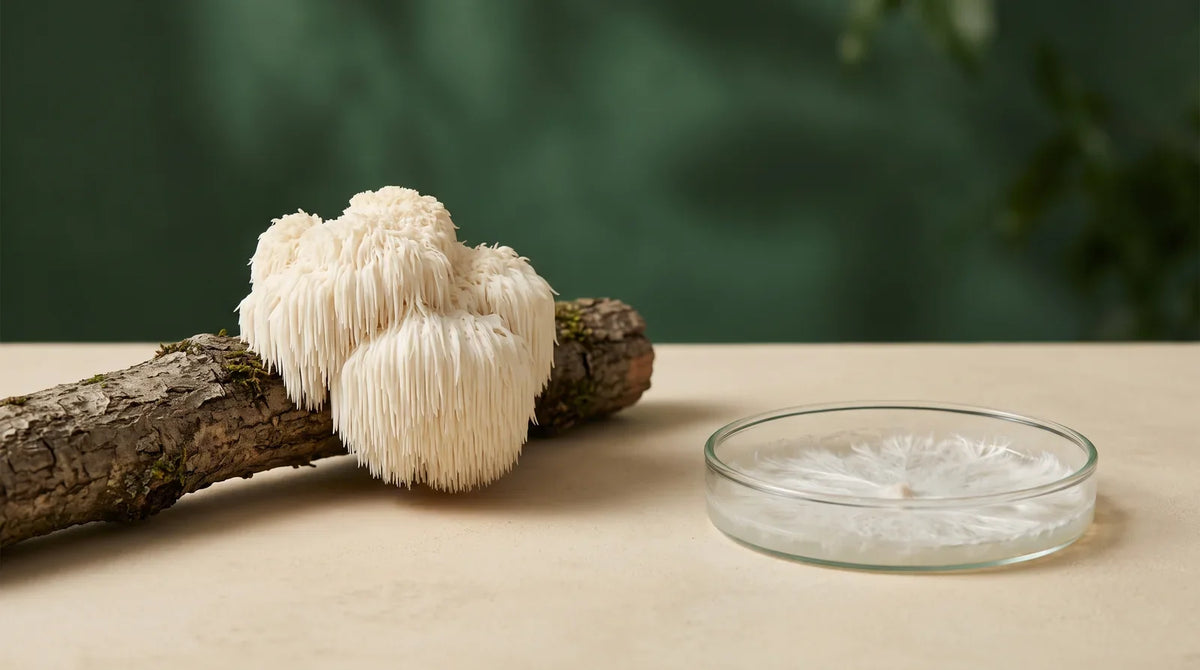
The fruiting body is the visible mushroom; mycelium is its network of fungal filaments. Mycelium is not a root. Knowing which material a supplement contains helps you compare like with like.
Start with the material, not a slogan
A label that only says “mushroom complex” leaves an important question unanswered. Look for the species, the part used and the amount per serving. Ask whether the stated weight refers to an extract or to unextracted material. Those details describe what you are buying before any benefit claim enters the comparison.
Do not turn the distinction into a blanket ranking
Fruiting body and mycelium are not interchangeable descriptions. But saying one brand uses fruiting body does not prove that every other preparation is ineffective. A meaningful performance comparison needs relevant testing or a clinical comparison, not a picture of a mushroom beside the word “roots.”
What Clarimind uses
Clarimind’s label identifies 500 mg of organic Lion’s Mane fruiting-body extract per two capsules, standardized to 30% beta-glucans. This is an ingredient-level description. The complete supplement also contains Bacopa, citicoline, Rhodiola and L-Theanine; it is not a single-ingredient mushroom product.
A useful question to send any brand
Ask: “Which fungal material is in the finished serving, how much of it is present, and what documentation supports the stated composition?” Keep the response with the label so you can compare actual products rather than broad categories.
Fruiting body and mycelium at a glance
Royal Botanic Gardens, Kew explains that mushrooms are reproductive structures, while mycelium is a network of thin strands called hyphae. Mycelium can play a root-like role, but fungi do not have plant roots.
| Question | Fruiting body | Mycelium |
|---|---|---|
| What is it? | The mushroom's reproductive structure. | A network of fungal filaments. |
| What should the label identify? | The species, fruiting body and preparation. | The species, mycelium and preparation. |
| Does the name prove a health benefit? | No; the specific preparation and supporting evidence matter. | No; the same evidence standard applies. |
A three-step buying checklist
- Identify the material. Find the fungal part on the label or ask the brand. A mushroom photograph alone does not answer the question.
- Compare a complete serving. Record capsules per serving, ingredient milligrams and any stated standardization together.
- Check the documentation. Ask for evidence that supports the actual label specification. A quality claim is more useful when you can check what it refers to.
For Clarimind, those label details are two capsules, 500 mg of organic Lion’s Mane fruiting-body extract and 30% beta-glucans. See the Supplement Facts when comparing another product.
Quick answer
Does fruiting body mean clinically proven?
No. Sourcing and clinical effectiveness are different questions. Ingredient studies do not prove results for the finished Clarimind formula.
Sources and further reading
- Royal Botanic Gardens, Kew: mycelium and fungal structures
- Clarimind Supplement Facts and ingredient amounts
Explore the related guide · Read the research and editorial approach · See the Clarimind formula
Written by Clarimind Health, the brand behind the product discussed here. Educational information, not individual medical advice. Ingredient research does not establish results for the finished Clarimind formula.